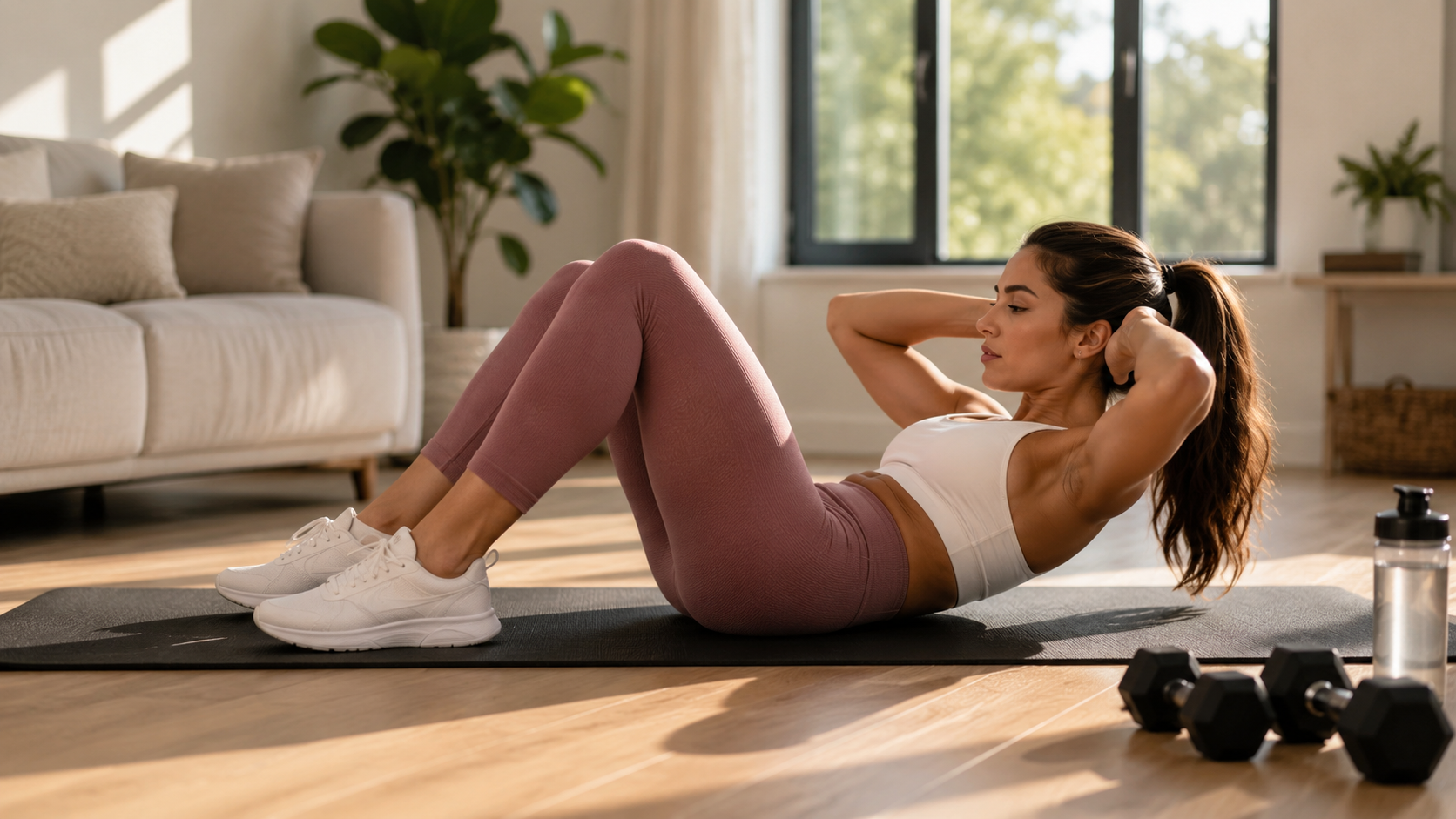
Looking for a quick core workout you can do at home without any equipment?
This 15 minute ab workout targets your entire core, including the upper abs, lower abs, obliques and deep stabilising muscles. It’s beginner friendly, requires nothing more than an exercise mat, and can be completed almost anywhere.
Whether you’re training for better posture, a stronger core, improved athletic performance, or simply want to feel fitter, this workout is an excellent place to start.

What You’ll Need
- Exercise mat or soft surface
- Water bottle
- Comfortable workout clothes
No weights, machines or gym membership required.
Workout Structure
Perform each exercise for 45 seconds.
Rest for 15 seconds before moving to the next exercise.
Complete all 6 exercises in order.
Beginners: 2 rounds
Intermediate: 3 rounds
Advanced: 4 rounds
Total time:
- 1 round: 6 minutes
- 2 rounds: 12 minutes
- 3 rounds: 18 minutes
- 4 rounds: 24 minutes
Exercise 1: Crunches
How To Perform
- Lie on your back with knees bent.
- Place fingertips lightly behind your ears.
- Keep your lower back pressed into the floor.
- Lift your shoulders towards your knees.
- Slowly lower back down.
Common Mistakes
- Pulling on your neck
- Using momentum
- Lifting your entire back off the floor
Focus
Upper abdominal muscles.

Exercise 2: Leg Raises
How To Perform
- Lie flat on your back.
- Place hands beside your hips or underneath your lower back.
- Keep legs straight.
- Slowly raise legs until they are vertical.
- Lower with control without letting your feet touch the floor.
Common Mistakes
- Arching the lower back
- Dropping the legs too quickly
Focus
Lower abdominal muscles.

Exercise 3: Russian Twists
How To Perform
- Sit on the floor with knees bent.
- Lean back slightly.
- Lift your feet off the floor if comfortable.
- Rotate your torso from side to side.
- Keep movements controlled.
Common Mistakes
- Moving only the arms
- Rushing through repetitions
Focus
Obliques and rotational core strength.

Exercise 4: Bicycle Crunches
How To Perform
- Lie on your back.
- Bring knees up to 90 degrees.
- Rotate your torso.
- Touch opposite elbow towards opposite knee.
- Alternate sides smoothly.
Common Mistakes
- Pulling on the neck
- Going too fast
Focus
Upper abs, lower abs and obliques.

Exercise 5: Flutter Kicks
How To Perform
- Lie flat on your back.
- Lift both legs a few inches from the floor.
- Alternate small kicking movements.
- Keep your core braced throughout.
Common Mistakes
- Allowing the lower back to arch
- Raising legs too high
Focus
Lower abs and hip flexors.

Exercise 6: Plank
How To Perform
- Place forearms on the floor.
- Keep elbows directly under shoulders.
- Create a straight line from head to heels.
- Brace your core and squeeze your glutes.
Common Mistakes
- Hips sagging
- Hips too high
- Looking forward excessively
Focus
Entire core, lower back and stabilising muscles.

Best Time Of Day To Train Abs
The truth is that the best time is whenever you can consistently do the workout.
That said:
Morning
Great for building routine and starting the day with energy.
Before Strength Training
Can be useful as part of a warm up if you keep intensity moderate.
After A Workout
Often ideal because your body is already warm and ready to move.
Will This Give Me A Flat Stomach?
Core workouts strengthen and develop your abdominal muscles.
However, visible abs or a flatter stomach primarily come from reducing overall body fat through:
- Consistent exercise
- Healthy nutrition
- Adequate sleep
- Calorie control
Think of this workout as building the muscles underneath while your diet helps reveal them.
How Often Should You Do This Workout?
Beginners:
2 to 3 times per week.
Intermediate:
3 to 5 times per week.
Advanced:
Up to 6 times per week alongside a balanced training programme.
Aim for at least one recovery day each week.
Final Thoughts
You don’t need fancy equipment or hours in the gym to strengthen your core.
This simple 15 minute ab workout challenges your upper abs, lower abs and obliques using nothing but your bodyweight. Focus on quality movement, maintain good form, and stay consistent.
Remember: a stronger core doesn’t just help your appearance. It can improve posture, support athletic performance, reduce injury risk and make everyday activities feel easier.
Leave a Reply